What Therapy Is Like: Types of Therapy and How They Shape the Experience in the Room
Why Therapy Feels So Different From Person to Person
One thing that often comes up when people talk about therapy is just how different their experiences can be.
It’s not uncommon for someone to share something about their session and be met with a genuinely surprised reaction—something like, “Wait, that’s what you do in therapy?” or “Wow, your therapist said that?” Sometimes it’s even a mix of curiosity and disbelief, especially when comparing notes with friends who seem to be having very different kinds of experiences in their own therapy.
Therapy Is Not One Single Experience

And in a way, that makes sense. Therapy isn’t actually a single experience, even though we tend to use one word for it. What people mean when they say “I’m in therapy” can look and feel quite different depending on how they show up in the room, who they’re sitting with, and the type of therapy or approach their therapist is working from.
Some sessions can feel structured and goal-oriented, while others feel more open-ended and reflective. Some stay close to present-day stressors and coping strategies, while others move more deeply into past experiences or relational patterns. And in many cases, it’s not just the topics that differ—it’s the entire experience of being in the room.
While I’ll speak a bit about how different types of therapy and a therapist’s approach can shape how sessions unfold, it’s important to emphasize that there is no one “right way” to do therapy—for either client or therapist. At its core, therapy is still an experience unfolding between two (or more) people. So let’s get into it.
Cognitive Behavioral Therapy (CBT) and Structured Approaches
Some approaches focus on patterns of thought and behavior. Therapy can feel goal-directed and collaborative, with an emphasis on understanding how thoughts, feelings, behaviors, and ways of relating all influence one another.
Your experience in the room might feel more direct and solution-focused, with attention to how these patterns connect in meaningful ways. Over time, you may develop a greater sense of clarity and understanding around what you would like to shift, and feel more equipped to navigate difficult situations.

Psychodynamic and Insight-Oriented Therapy
Other forms of therapy make space for gaining insight by going beneath the surface and attending to emotional experience that may not always be immediately accessible in conscious awareness. In this kind of work, you might feel encouraged to notice how past experiences remain relevant to what brings you into therapy today.
You may find yourself exploring childhood or adolescence with curiosity, trying to understand which core experiences from the past continue to shape how you move through the world and relationships today. Your experience in the room may feel reflective, exploratory, and emotionally layered.
Somatic Therapy and Body-Based Awareness
Rather than primarily engaging through cognition, these approaches focus more directly on what is sensed, expressed, and held in the body. For many people, this involves beginning to relate to internal bodily experience in a way they’re not used to doing in everyday life. Thoughts and feelings are still present, but are often noticed through bodily experience and sensation alongside reflection and meaning-making.
You may become aware of tension, movement, breathing, activation, stillness, or shifts in your nervous system as they arise. The experience in the session may feel less analytical and more embodied.
Awareness-Based Approaches
Similarly, certain therapeutic approaches place greater emphasis on present-moment awareness and less emphasis on gaining insight through analysis of past experiences. In everyday language, we often use awareness and insight interchangeably, but in therapy there is an important distinction. Reflecting on past experiences may help you understand patterns in your thoughts, feelings, and behaviors, which can lead to greater clarity and insight.
These approaches instead emphasize what is happening as you notice your experience in real time.
In session, you might experience a slowing down of time itself, where you become more attuned to what is happening internally in the moment. As you share a memory, a plan, or a conflict, you might be invited to stay with your experience of sharing it as it happens.
You may begin to recognize thoughts, feelings, bodily sensations, or emotional shifts that were previously moving by unnoticed while you were speaking.
This slowing down can be essential not only in understanding yourself, but in learning how to feel, tolerate, and accept your experience more fully.
Relational Therapy and the Experience Between Two People
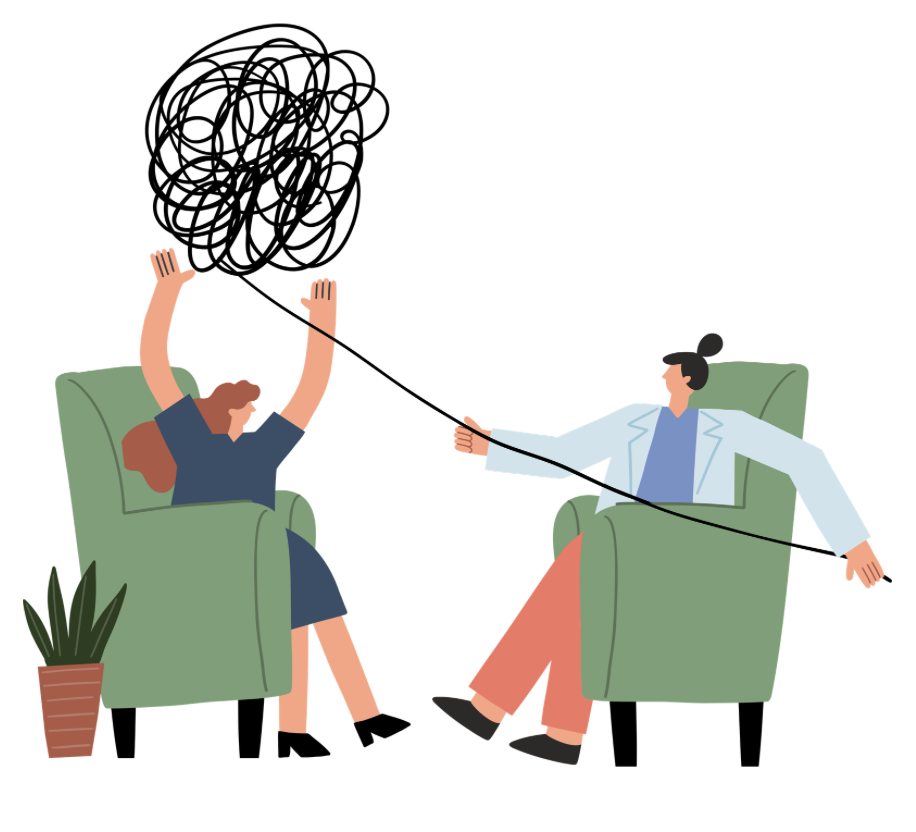
Relationally-oriented approaches place greater emphasis on what happens between you and the therapist in the session itself. You might be invited to describe your experience of your therapist directly to them, or to notice what emotions, assumptions, or reactions arise within the relationship.
For many people—especially those who struggle in relationships—this can feel unfamiliar or vulnerable. At the same time, it can also be deeply meaningful to speak openly about what is happening with the therapist present. In these sessions, therapy becomes less about talking about relationships in general, and more about experiencing relationship as it unfolds.
Images, metaphors, or felt impressions may also emerge naturally in the space between you and the therapist, offering a different way of understanding thoughts and feelings that can sometimes be difficult to put into words directly.
Therapy Is a Holistic and Integrative Experience
While there are therapists who work primarily from one specific orientation, most take a more holistic and integrative approach, drawing from several frameworks depending on the client’s needs and what emerges in the session. Your felt experience in the room may vary not just based on who you are sitting with, but also on how you are feeling and showing up in that particular moment.
What can sometimes get lost when we talk about different “types” of therapy is that, in practice, therapy is not a fixed experience. It unfolds in real time between two (or more) people. The same therapist may feel different from session to session, not because their approach has changed, but because the internal landscape of the moment has changed.
In that sense, therapy is less about applying a single model consistently, and more about attending to what’s happening in the room between client and therapist.
What Matters Most in Therapy Is the Experience as It Happens
From this perspective, what begins to matter most is not only what you are talking about, but how you are experiencing yourself as you talk. Not only what you are understanding, but what you are noticing—emotionally, physically, relationally—as your experience shifts and moves.
This is where approaches that emphasize awareness, relational dynamics, and somatic experience begin to overlap.
In these kinds of sessions, attention often moves gently between different layers of experience: your thoughts, your emotions, your body, and what’s happening between you and the therapist in the room. Rather than organizing therapy solely around insight or behavior change, the focus may begin to include what is emerging in the present moment itself.

And in this way, the work becomes less about stepping outside of your experience to understand it from a distance, and more about staying close enough to it that something new can be felt, recognized, or understood as it is happening.
Therapy as a Shared Human Experience
Therapy is an essential space for many people. It offers a place for self-discovery, growth, and connection, and across approaches, it carries a shared invitation: that you don’t have to make sense of your experience alone.